March 16, 2026


The way products are discovered and purchased is shifting from storefronts to AI conversations. Behind that shift is a stack of infrastructure that makes it all work. Here's the full picture, layer by layer.
And yet, when someone asks ChatGPT for a recommendation in their category, this store doesn't exist. When a shopper uses Gemini to compare options, their products never surface. Not because their products are bad. Because nothing in their infrastructure was built for the AI agents now shopping on behalf of their customers.
AI-referred shopping sessions jumped 527% year-over-year in 2025.[1] ChatGPT now reaches over 800 million weekly users.[2] Google shipped autonomous browsing in Chrome in January 2026.[3] Perplexity's browser handles full-task shopping across platforms.[4] These aren't experiments. They're products with real users completing real purchases without ever landing on a product page.
The storefront era isn't ending. But the front door has moved. It's a conversation now.
What It Takes, End to End
For an AI agent to discover a product, evaluate it, and complete a purchase on someone's behalf, seven layers of infrastructure have to work together.
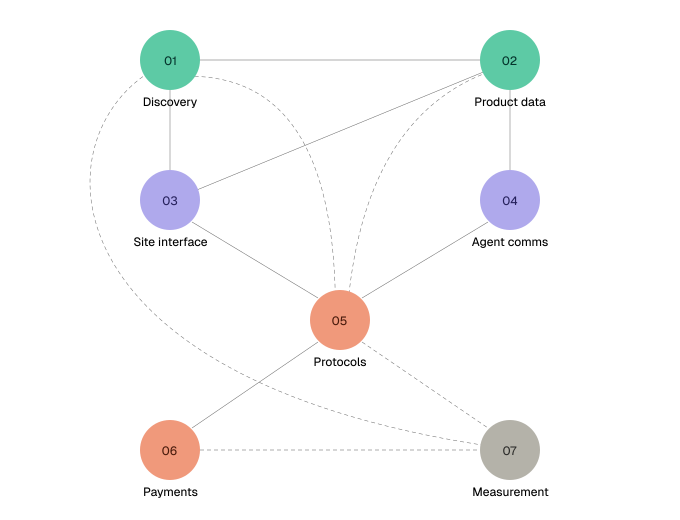
Layer 1:
Discovery
How your products show up when someone asks an AI for a recommendation. If agents can't find you, nothing else matters.
GEO
Layer 2:
Product data
Complete product attributes, accurate pricing, real-time availability, and clear return policies, all formatted so machines can read them. If your data has gaps, agents move on to the next merchant.
Catalog
Feed
Layer 3:
Site interface
How agents interact with your website directly, using structured tools instead of guessing at your UI.
WebMCP
Layer 4:
Agent communication
How agents access backend systems and coordinate with each other behind the scenes. Essential plumbing you never touch.
MCP
A2A
Layer 5:
Commerce protocols
How agents initiate and complete purchases on behalf of shoppers. Two open standards, both live, most merchants will need both.
UCP
ACP
Layer 6:
Payments & trust
How agents pay and prove the shopper authorized the transaction. Tokenized, scoped, and cryptographically signed.
A2P
SPT
Layer 7:
Measurement
How you understand what agents did and why they chose you. The biggest unsolved problem in the stack.
TBD (Emerging tech)
Layer 1: Discovery (how agents find you)
Generative Engine Optimization, or GEO, is how brands show up in AI-generated answers. When someone asks an AI assistant for a recommendation, the assistant doesn't return a list of links. It builds an answer, picks sources, and names specific products. If your brand isn't part of that answer, you weren't considered.
Research from Princeton shows that AI systems favor authoritative, well-structured content from credible third-party sources over brand-owned marketing copy.[5] What matters is clarity, consistency across platforms, and information that's easy for a model to extract and reassemble. Product descriptions need to be as readable by machines as they are persuasive to humans.
This is quickly becoming a core marketing discipline alongside SEO. By mid-2026, most teams will track how often their brand appears in AI-generated answers the same way they track search rankings today.
Status:
Live. Already determines whether agents recommend you.
Who owns it:
Merchants
Layer 2: Product Data (the source of truth)
Every other layer depends on this one. Complete product attributes, accurate pricing, real-time availability, and clear shipping and return policies. This is the source of truth that agents, protocols, and AI platforms all read from.
Merchants with thorough, well-structured product data see dramatically better agent discovery. Those with gaps and inconsistencies get skipped. Agents don't tolerate ambiguity. When data is incomplete, they simply move on to the next merchant with cleaner information.
One major European retailer published that both of the leading commerce protocols require the same foundation: structured product information, accurate pricing, availability, images, and return policies, all kept current and machine-readable.[6] Their comparison is useful. This is like the early days of product feeds for shopping platforms, but with more moving parts.
This is the layer most companies underinvest in. It's also the one that determines everything else.
Status:
Live. The most common gap in the stack.
Who owns it:
Merchants. Platforms provide the infrastructure, but data quality is on store owners.
Layer 3: Site Interface (the agent-ready storefront)
When AI agents visit a website today, they take screenshots, read the page code, and try to guess which buttons do what. It's slow, unreliable, and expensive. WebMCP, a new standard from Google and Microsoft released in early preview in February 2026, changes this.[7] It lets websites declare their capabilities directly to agents. Instead of guessing, the agent knows exactly what actions are available and how to use them.
Think of it as making your site readable by agents the same way responsive design made sites usable on phones. Chrome's documentation positions this alongside existing tools for connecting agents to backends. One handles off-site connections. WebMCP handles what happens when the agent is actually on your site.
When mobile arrived, the sites that adopted responsive design early won the distribution game. The same pattern is forming here.
Status:
Early preview. Broader support expected mid-to-late 2026.
Who owns it:
Engineering teams. Only relevant when agents visit your site rather than completing transactions elsewhere.
Layer 4: Agent Communication (the plumbing)
Two protocols handle the behind-the-scenes communication that makes agentic commerce work. MCP (Model Context Protocol) standardizes how agents access backend tools and data. A2A (Agent2Agent) enables agents to coordinate with each other, which matters when a shopping agent needs to work with a logistics system, a payment provider, and a returns process in a single transaction.
These aren't commerce-specific, but they're essential plumbing. Major platforms including SAP, Microsoft, and several payment providers have already deployed these connections for catalog access, payment processing, and order management.[8] A single purchase through an AI agent might use multiple protocols working together in one flow.
Status:
Live and widely adopted.
Who owns it:
Your platform. Merchants don't interact with this directly.
Layer 5: Commerce Protocols (the checkout layer)
Two open standards now enable AI agents to execute purchases on behalf of shoppers.
UCP (Universal Commerce Protocol)
Developed by Google and Shopify with endorsement from Walmart, Target, Visa, Mastercard, and over 20 others, covers the full shopping journey. Discovery, checkout, payment, order tracking, and post-purchase support. It powers checkout inside Google's AI Mode and the Gemini app.[9]
ACP (Agentic Commerce Protocol)
Developed by OpenAI and Stripe and now governed by a foundation that includes Anthropic and Block, ACP was originally built to power purchases inside AI conversations. It was made fully open-source in February 2026. As of late March, OpenAI retired Instant Checkout and repositioned ChatGPT as a discovery layer. Purchases now complete through merchant apps or on the merchant's own site.[10]
Status:
Both live.
Who owns it:
Your platform. Shopify handles UCP. Stripe handles ACP through its Agentic Commerce Suite. Merchants configure settings.
Layer 6: Payments and Trust (the consent layer)
For an AI agent to make a purchase on someone's behalf, there needs to be a system that proves the shopper actually authorized it. Google's payment protocol uses cryptographically signed approvals that tie each transaction to a specific intent, cart, and payment method. Stripe's approach scopes payment tokens to a specific merchant and cart total so they can't be reused or redirected.
Visa, Mastercard, Klarna, and several other payment networks have already launched or announced support for agent-initiated payments. This layer is in production and expanding monthly.[11]
Status:
Live and scaling.
Who owns it:
Payment providers.
Layer 7: Measurement (the blind spot)
This is the biggest open question in the stack.
Today, when a shopper clicks a link from ChatGPT and lands on your website, your analytics tools can see that visit and track the purchase. It shows up as a referral, similar to traffic from Google or Instagram.
But agentic commerce is moving in a different direction. Increasingly, the AI agent completes the purchase on behalf of the shopper without ever visiting your website. The agent talks directly to your checkout system through the commerce protocols described in Layer 05. No page loads. No browser session. No analytics event fires. The order appears in your backend, but your tracking tools never saw a visitor.
Even when your analytics do pick up a referral from an AI platform, they only tell you that someone arrived and bought something. They don't tell you what the agent compared before recommending you, which competitors it evaluated, what product details tipped the decision, or how many times agents considered your products and chose someone else.
In short, you can see when a sale happens. You can't see how or why the agent chose you. And without that understanding, improving your position across the rest of the stack becomes guesswork.
Shopify is furthest ahead, offering order-level tracking that shows when a sale came through an AI agent. Most of the ecosystem is still figuring it out. Expect 18 to 24 months before reliable measurement tools mature across the industry.[12]
Status:
Emerging. The largest gap in the stack.
Who owns it:
An open problem. Early investment in tracking infrastructure will pay off when the frameworks catch up.
What all of this means in practice
Seven layers. But your platform handles the majority of them. Shopify, Stripe, SAP, Salesforce, BigCommerce. They're building the protocol connections, the payment systems, and the agent communication infrastructure.
The two layers your platform cannot do for you are product data quality and visibility optimization. Those are the layers that determine whether agents discover your products at all.
For many large retailers, supporting these protocols is no longer seen as a competitive advantage. It's becoming a cost of entry.
The real advantage comes from the layers you own.
About
I'm Jaime Carrasco, a product designer who specializes in ecommerce. I explore how AI is reshaping our world and write about how to understand and navigate this new paradigm.
© 2026. Made by @jaimcarrasco